If your goal is to train MMA, the best place to start is grappling. You will eventually need strong striking, but learning how to control an opponent, defend takedowns, escape bad positions, and fight from the ground gives you a foundation that carries into every part of MMA.
That doesn’t mean you should ignore striking. Boxing, kickboxing, and other striking skills become essential as you progress. But for a beginner, grappling offers one of the best ways to develop the control, conditioning, and composure you need before adding more pieces to your game. It also exposes weaknesses quickly, which gives you a clear path for improvement.
Crazy 88 started as a Jiu-Jitsu school in Elkridge in 2005 and has grown into three full-service MMA gyms across Central Maryland. For anyone serious about learning MMA, the approach is straightforward: build your grappling foundation first, add striking, and then learn how to combine both under MMA rules.
Why Does Grappling Come First in MMA?
There are three main reasons to start with grappling, and any one of them would be enough to make the case.
Whoever Controls the Takedown Controls the Fight
In MMA, the fighter with better takedowns and takedown defense decides whether the fight happens standing, against the cage, or on the mat. If you can take someone down at will, their striking only matters for as long as you let it. If you can stop every takedown, you get to keep the fight in the range you prefer.
The takedown threat also changes how everyone strikes. A fighter who’s worried about getting shot on can’t sit down on punches or throw kicks freely. A fighter who knows his opponent can’t take him down strikes with total confidence. Grappling isn’t just one part of MMA. It sets the conditions for every other part.
Grappling Is the Safest Way to Train Hard Early
In grappling, you can go 100 percent from your first months. Live rolling against a fully resisting partner is safe for beginners when it’s supervised, because the goal is control and a tap, not damage. A new student in a good BJJ class can do five or six live rounds a session, several sessions a week.
You can’t do that with head strikes. Hard striking sparring accumulates damage, so responsible gyms keep striking sparring light and controlled for beginners. The result is simple math: on the mat, a beginner gets far more real reps against real resistance, far sooner. That’s how skill gets built.
A Striker with No Takedown Defense Has One Bad Night Coming
Here’s the failure mode we see all the time: someone spends a year training kickboxing. Their hands are sharp, their kicks are improving, and they have solid cardio on the pads. Then they step into MMA sparring and feel great for the first exchange. A training partner with six months of grappling changes levels, gets in on a leg, and puts them on their back.
The takedown itself isn’t necessarily the problem. What happens after it is. They don’t know how to frame, so they push with straight arms and expose their back. They don’t know how to use the wall to get back to their feet, so they try to bench-press their way out from underneath someone. Ninety seconds later, their gas tank is empty. The round is over, or they’ve tapped.
In an amateur fight, that can be the entire night. Every striker who skips grappling leaves a major hole in their MMA game. The question is whether they discover that hole in the gym, where it becomes a lesson, or in the cage, where it can become a loss.
Should You Start with Striking for MMA?
Most people want to start with striking, and it makes sense why. Striking is what you see on broadcasts. Knockouts make the highlight reels. Hitting pads feels like fighting from the very first class, and grappling, at first, feels like being smothered by someone who knows exactly what they’re doing.
It’s the most common starting point we see from people who come to us wanting to train MMA. And it’s a fine way to start if your goal is fitness or self-defense. But if your goal is MMA, starting with striking costs you time.
A striker who starts grappling at month twelve is starting the slowest-developing skill in the sport a full year late. Meanwhile, they’ve often built habits that work against them in MMA, like a tall, square stance with heavy lead-leg weight that’s easy to shoot on, or kicks thrown without any thought of getting caught. Realistically, most strikers who come to MMA late spend several months catching up on grappling basics that a mat-first student already has, and they’re still behind on takedown defense when MMA sparring starts.
What About Boxing, Judo, Karate, or Taekwondo?
Every martial art brings something to MMA, but they don’t all make an equally good first step. Here’s how the most common starting points compare for someone whose goal is MMA.
| Martial Art | What It Gives You for MMA | What’s Missing | Verdict as a First Art |
|---|---|---|---|
| No-Gi BJJ | Ground control, submissions, escapes | Takedowns, striking | Best first choice for most adults |
| Wrestling | Takedowns, takedown defense, top control, getting up | Submissions, striking | Best first choice if you have a real wrestling room |
| Muay Thai | Kicks, clinch, kick defense | Takedown defense, ground game | Best striking art to add at month three or four |
| Boxing | Sharp hands, head movement | Kicks, clinch, takedown awareness | Add later to sharpen your punching |
| Judo | Throws, clinch control, top pressure | Striking, depth on the ground under MMA rules | Strong base if available; adapt grips for no-gi |
| Karate or Taekwondo | Distance management, kicking | Takedown defense, ground game | Useful background, not the best starting point |
If you already have one of these backgrounds, you’re not starting over. You’re starting your grappling and fill-in work from a better place than a true beginner.
Should You Learn Wrestling or BJJ First for MMA?
Both wrestling and Brazilian Jiu-Jitsu are excellent starting points for MMA, and either can give you the grappling foundation you need. The difference is what each one emphasizes. Wrestling focuses on takedowns, scrambles, top pressure, positional control, and getting back to your feet. Brazilian Jiu-Jitsu emphasizes submissions, guard work, escapes, and staying effective when you’re fighting from your back.
Neither is inherently better. The right choice depends on your goals, your experience, and what you want to develop first. Here’s how to decide.
Start With Wrestling If…
- You have access to a wrestling room: A real high school or college program, an adult wrestling club, or an MMA gym that runs dedicated wrestling sessions. Wrestling is hard to learn from YouTube and harder to learn without partners who’ve done it.
- You’re younger or have a strong athletic background: Wrestling is explosive and conditioning-heavy. If you played contact sports or you’re in your teens or twenties, your body is built for the pace.
- Your knees, neck, and back are healthy: Shots, sprawls, and hard scrambles put real load on all three. A clean injury history matters more here than in almost any other combat sport.
- You like a grind: Wrestling practice is relentless by design. If that sounds fun rather than miserable, it’s a sign.
Verdict: If a real wrestling room is open to you and your body can handle the pace, wrestle first. It’s the most direct path to controlling where MMA fights happen.
Start With BJJ If…
- You don’t have a wrestling room: This is most adults. Dedicated adult wrestling programs are rare, and BJJ academies are everywhere.
- You’re starting in your thirties or later: BJJ lets you train hard at a pace you control, and it rewards technique over explosiveness.
- You have an injury history: Knees, shoulders, or back issues are far easier to manage in a BJJ class than in a wrestling room.
- You want structure and visible progress: A Brazilian Jiu-Jitsu program with a fundamentals track and a belt system gives you a clear path and clear milestones.
If you go the BJJ route with MMA in mind, lean toward No-Gi Brazilian Jiu-Jitsu. Without the gi, there are no collar or sleeve grips to rely on, the pace is faster, and the positions look much more like what happens in a cage. Gi training still sharpens your technique, and many fighters train both.
Verdict: If you don’t have a wrestling room, start BJJ, lean No-Gi, and work takedowns and takedown defense from day one. You’ll give up very little.
If you already have one of these backgrounds, you’re not starting over. You’re starting your grappling and fill-in work from a better place than a true beginner.
When Should You Start Striking Training for MMA?
For most beginners, month three or four is a good time to add striking. That window isn’t arbitrary. By this point, a consistent beginner should be able to fall safely, stay composed on the bottom, and maintain a basic stance while defending a takedown. Your conditioning has a foundation, and you’ve established the habit of training two or three times a week. Adding a striking session builds on that foundation rather than overwhelming you with too much at once.
Striking skills also tend to develop faster than grappling skills. With a few weeks of focused practice, most beginners can develop a functional jab, cross, basic footwork, and defensive habits. Waiting too long has a downside, too. If you spend a full year grappling before throwing your first kick, your striking defense will still be extremely inexperienced when you eventually start MMA sparring. You’ll have to learn the basics while also dealing with the pressure and unpredictability of mixed-rules training.
Is Muay Thai or Boxing Better for MMA?
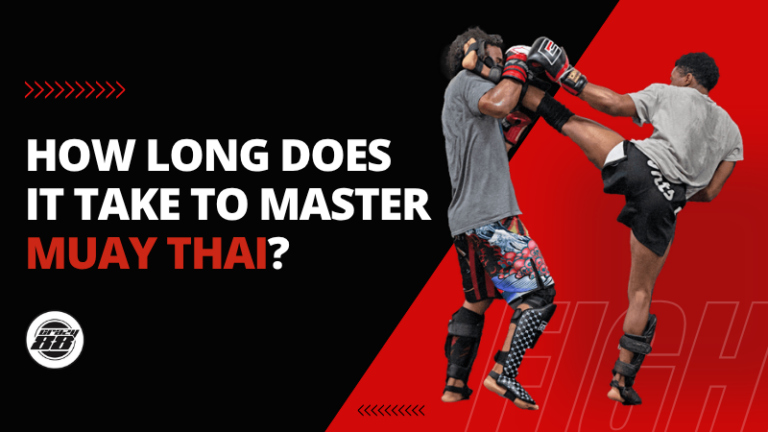
Muay Thai is the better first striking art for MMA. Boxing develops exceptional hands and is worth adding later to sharpen your punching, but Muay Thai transfers more directly to the cage. There are three main reasons:
- The clinch: Muay Thai clinch work teaches you to control posture, frame, knee, and off-balance an opponent in close. That’s exactly what happens against the cage in MMA. Boxing has no real clinch game, because the referee breaks it up.
- Kicks and kick defense: Leg kicks are one of the most effective weapons in MMA, and checking them is a skill you need on day one of sparring. Boxing doesn’t teach either.
- The stance: A boxer’s habit of bending at the waist to slip punches puts the head right where a knee or a takedown is waiting. Muay Thai keeps you upright and balanced on both legs.
Crazy 88’s Muay Thai Kickboxing classes are built around this type of training, with fundamentals for beginners and a progression that carries straight into MMA training in Central Maryland.
What Does a Beginner’s First Year of MMA Training Look Like?
Here’s a realistic first year for a working adult who wants to train MMA and has never trained before. The session counts assume classes of about an hour, and they’re targets, not requirements. Life happens, and consistency beats volume every time.
| Month Range | Focus | Sessions / Week | Milestone |
|---|---|---|---|
| Months 1–2 | Grappling fundamentals. BJJ or No-Gi intro classes: positions, escapes, safe falling, basic takedown defense. | 2–3 grappling | You can survive a full live round from a bad position without panicking or gassing out. |
| Months 3–4 | Keep grappling, add striking. Muay Thai fundamentals: stance, footwork, the basic punches and kicks, checking kicks. | 2–3 grappling + 1–2 Muay Thai | You can shoot a basic takedown and sprawl on one and throw clean 3–4 strike combinations on pads. |
| Months 5–6 | Build both bases. Live grappling rounds standing up, Muay Thai clinch work, light technical striking sparring. | 2–3 grappling + 2 Muay Thai | You can defend a takedown and work back to your feet. Optional: first grappling tournament. |
| Months 7–9 | Start assembling. Add an MMA class: striking-to-takedown entries, cage wall work, ground strikes from top. | 2 grappling + 2 Muay Thai + 1 MMA | You can chain a strike into a takedown and get up off the wall when you’re the one being pinned. |
| Months 10–12 | Blend under pressure. Controlled MMA sparring, positional rounds that mix strikes and grappling, conditioning. | 4–5 total, 1–2 of them MMA | Coach evaluation: are you on a competition track, or building a stronger base first? |
Progress isn’t strictly tied to the calendar, so a coach may move you faster or slower based on how you’re doing. If you have a wrestling or striking background, you’ll compress the early stages. If the goal is to eventually compete, months ten through twelve are when a coach starts looking at whether you’re ready for the competition team track.
Not sure which month-one class fits you? Try Crazy 88 free for 7 days and a coach will map out your starting point.
Should You Just Take an MMA Class Instead?
Here’s the honest answer: An MMA class is where the pieces come together, not where they’re built.
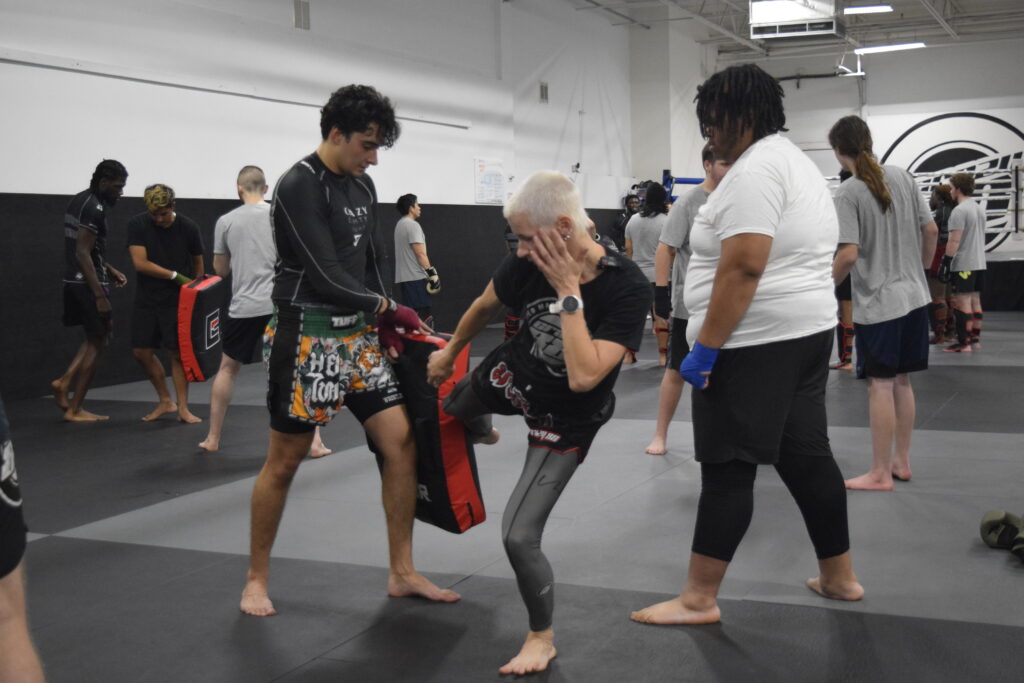
In a typical hour, an MMA class has to cover striking, takedowns, cage work, and ground fighting. That might leave only 15 to 20 minutes for each. It’s a great workout, it’s fun, and it’s a smart way to sample everything while getting the conditioning of a fighter. Our Mixed Martial Arts classes welcome beginners, but they work best once you have a grappling and striking base to bring into them. But if your goal is to compete, taking only MMA classes means learning everything at a shallow level. You get a few reps of a guard pass, a few of a teep, and a few of a double leg, but not enough repetition to make any of them reliable against someone who’s actively resisting.
Here’s what we recommend for anyone with competition in mind: build your foundation in dedicated grappling and Muay Thai classes, then use MMA class to put those skills together.
How Long Before Your First Amateur MMA Fight?
For most people who start from zero and train consistently, the realistic range is 12 to 24 months before a first amateur MMA bout. Someone with a real wrestling or striking competition background might be ready in six to twelve. Plenty of people take longer, and there’s nothing wrong with that.
A good coach doesn’t clear a fighter by the calendar. They clear a fighter by a checklist. Here’s what we look for before we’d put someone in a cage:
- You can stop a takedown or get back up against a resisting training partner, not just in drills.
- You can survive and escape bad positions like mount, back control, and the cage wall without panicking.
- You’ve done regular, controlled hard sparring and you can take a clean shot without shutting down.
- Your conditioning holds for a full bout. Amateur MMA rounds are shorter than pro rounds, but three rounds of everything at once is a different kind of tired.
- You can make weight in a healthy, repeatable way.
- You’re coachable under pressure. You listen between rounds and can change what you’re doing.
Many fighters also test themselves first in a grappling tournament or an amateur Muay Thai or kickboxing bout. It’s a lower-stakes way to experience adrenaline, a weigh-in, and a crowd before stepping into MMA.
How to Choose an MMA Gym for Fight Training
If you’re serious about competing, the gym you pick matters as much as the art you start with. A hobbyist gym can be a great place to train, but it can’t develop fighters. Here’s what to look for:
- Professional, full-time coaches: Instructors who’ve put years into their art, competed themselves, and teach as a profession, not as a side gig one night a week.
- Active competitors on the roster: You get better by training with people who are better than you. If nobody in the room competes, nobody in the room knows what competition demands.
- Cornering experience: Coaches who’ve stood in the corner at amateur and pro events understand weigh-ins, commission paperwork, game plans, and what to say between rounds. You don’t want your coach learning that on your fight night.
- Takedowns on the schedule, not just BJJ: Plenty of gyms have a great guard game and no one who can teach a double leg or the sprawl that stops it. For MMA, you need both.
- A structured path for beginners: Fundamentals classes and a clear progression, so you build skills in order instead of getting thrown into the deep end.
- Hard training without ego: Real sparring with partners who look out for each other. The best fight gyms are intense and safe at the same time.
- Every discipline under one roof: Grappling, Muay Thai, and MMA in one place, on one schedule, with coaches who talk to each other about your development.
Train MMA at Crazy 88
Crazy 88 opened as a Jiu-Jitsu school in Elkridge in 2005, and we still build fighters grappling-first. Start with BJJ or No-Gi, add Muay Thai around month three, and put it all together in MMA class, under one roof with coaches who compete and corner. Try Crazy 88 free for 7 days. No experience needed. A coach will show you exactly where your MMA training should start.
- Crazy 88 Elkridge (Howard County) — (443) 283-1450
- Crazy 88 Owings Mills (Baltimore County) — (410) 999-1064
- Crazy 88 Severna Park (Anne Arundel County) — (443) 339-8130
Serving MMA students across Howard County, Baltimore County, and Anne Arundel County. Claim your 7-day free trial and start your mixed martial arts journey today.
Frequently Asked Questions
Can I start MMA with no athletic background?
Yes. Most people who walk into an MMA gym don’t have an athletic background, and that’s normal. Start with grappling fundamentals two or three times a week, let your conditioning build through training itself, and add striking around month three or four. Fitness is a result of showing up, not a requirement to start.
Do I need to wrestle in high school to be good at MMA?
No. A high school wrestling background is a real advantage, especially for takedowns and getting back to your feet, but plenty of strong MMA competitors started as adults. Adults without wrestling usually build their grappling base through BJJ, ideally No-Gi, and learn takedowns and takedown defense along the way.
How many days a week should a beginner train?
Two to three sessions a week is the right starting point for most beginners. That’s enough to retain technique without breaking your body down. Around month three or four, add one or two striking sessions. Four to five total sessions a week is a realistic target by the end of your first year.
Is BJJ enough on its own for MMA?
No. BJJ gives you the ground game, submissions, and the ability to survive bad positions, but on its own it doesn’t teach you to take someone down, stop a takedown, or handle strikes. For MMA you need BJJ plus takedowns and wrestling-style control, plus striking, ideally Muay Thai.
How old is too old to start training for MMA?
There’s no age limit on training MMA, and many members start in their 30s, 40s, and beyond. Competing is different: amateur fighters are usually in their 20s and 30s. If you’re starting later, BJJ first is the smartest, lowest-impact path in.
Related Articles