

Short answer: Brazilian Jiu-Jitsu has 5 primary adult belts: white, blue, purple, brown, and black. Counting the ranks beyond the black belt, the full IBJJF graduation system reaches 8 belt colors total, adding two coral belts and the red belt. Kids ages 4 to 15 progress through a separate 13-belt system.
Ask ten people how many belts are in Brazilian Jiu-Jitsu, and you’ll get a few different answers, and technically, more than one of them is right. Most practitioners count 5 adult belts, but the full BJJ belt system stretches all the way to a red belt reserved for grandmasters, and kids train under a separate 13-belt structure.
This guide breaks down the entire Brazilian Jiu-Jitsu belt order: every adult rank, black belt degrees, coral and red belts, the kids system, stripes, and how long it realistically takes to climb the ladder. Whether you’re brand new to BJJ training or a parent trying to decode your kid’s grey belt, this is everything you need to know.
Key Takeaways: Brazilian Jiu-Jitsu Belt System
- There are 5 primary adult BJJ belts: white, blue, purple, brown, and black.
- The full system extends beyond black to coral belts (7th and 8th degree) and red belts (9th and 10th degree), for 8 belt colors total.
- Kids ages 4–15 use a separate 13-belt system built around grey, yellow, orange, and green belts.
- A BJJ black belt takes roughly 10 years of consistent training for most practitioners.
- Stripes mark progress within a belt, not separate ranks, typically up to 4 per colored belt.
- BJJ promotions are earned through live performance, which is why Brazilian Jiu-Jitsu belt ranks carry so much weight compared to other martial arts.
BJJ Belt Order and Requirements
| Belt | IBJJF Minimum Age | Minimum Time in Grade | What It Represents |
|---|---|---|---|
| White | None | None | Beginner. Survival, escapes, and fundamentals |
| Blue | 16 | About 2 years (recommended) | First adult rank. Technical library expands rapidly |
| Purple | 16 | 18 months minimum | Advanced. Building connected systems, can help instruct |
| Brown | 18 | About 1 year minimum | Highest color belt. Refinement and personal style |
| Black | 19 | Degrees begin (3 to 5 years each) | Expert level. Addressed as “professor” |
| Coral (7th and 8th degree) | N/A | 31+ years at black belt | Master. Red-and-black, then red-and-white |
| Red (9th and 10th degree) | N/A | About 48+ years at black belt | Grandmaster. The highest rank in BJJ |
The BJJ Belt Order at a Glance
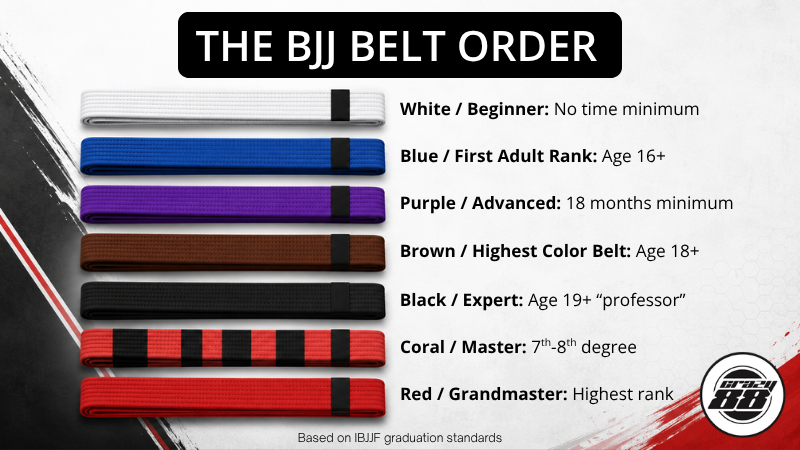
The complete adult Brazilian Jiu-Jitsu belt order runs: white, blue, purple, brown, black, coral (red-and-black, then red-and-white), and finally red.
When people ask how many belts are in Brazilian Jiu-Jitsu, the answer they’re usually looking for is 5, the colored ranks an active practitioner moves through from day one to black belt. But the full BJJ ranking system does not stop there. Black belt itself carries degrees, and the highest degrees are represented by coral and red belts worn by the sport’s most senior masters. Think of it as 5 belts for your training career, and a lifetime of rank beyond that.
The 5 Adult BJJ Belts Explained
White Belt (Beginner)
Every single person who steps onto the mat starts at white belt, no exceptions and no age minimum. The white belt phase is about survival: learning to escape bad positions, hold strong base positions, and stay calm while someone is actively trying to fold you in half. New students focus on fundamental movements, defensive posture, and building the timing that makes technique work against resistance. There is no required time at white belt. Your instructor promotes you when your skills earn it.
At Crazy 88, this is also where we set expectations early. We grade holistically from day one, effectiveness, skill, knowledge, mindset, and your individual goals, so white belts always know what they are working toward rather than just waiting for a stripe.
Blue Belt
Blue belt is the first adult promotion, and the IBJJF requires practitioners to be at least 16 years old to receive it. This is where your technical library explodes. Blue belts spend hundreds of hours on the mat developing a real guard game, chaining submissions together, and turning isolated moves into connected sequences. It is also famously the longest grind, and the rank where the most students drop out. The IBJJF recommends around 2 years at blue belt before purple, though skill, not the calendar, makes the final call.
We see this pattern at Crazy 88 exactly the way the sport is known for: blue belt is where most people either build a real game or walk away. It is the rank we coach students through most deliberately, because getting past it is what separates hobbyists from lifers.
Purple Belt
Purple belt marks the transition from intermediate to advanced Brazilian Jiu-Jitsu. A purple belt’s technique is refined and connected. They are no longer collecting moves, they are building systems that link positions, transitions, and finishes. Purple belts are also generally considered qualified to help instruct lower-ranked students, and you will often see them coaching white and blue belts through drills. The IBJJF requires a minimum of 18 months at purple before a practitioner is eligible for brown.
Brown Belt
Brown belt is the highest colored rank below black in the BJJ belt system. This stage is all about refinement, sharpening a personal style, closing technical gaps, and polishing the details that separate good grapplers from great ones. Brown belts typically have eight or more years of dedicated BJJ training behind them and grapple at a level most people never reach. The IBJJF requires practitioners to be at least 18 years old and spend a minimum of roughly 1 year at brown before earning black.
Black Belt
Black belt represents expert-level technical and practical skill, and holders are often addressed as “professor” on the mat. The IBJJF sets a minimum age of 19 for the rank. A BJJ black belt can break down positions, read opponents, and execute under pressure at the highest level. But here is the part beginners miss: black belt is not the finish line. It is the start of an entirely new phase of the journey, measured in degrees earned over decades.
Black Belt Degrees and What Comes After
Once you earn a black belt, progression continues through a system of degrees and eventually, entirely new belt colors.
Black Belt Degrees (1st to 6th)
Black belt degrees are earned over years of continued training and teaching. Under IBJJF guidelines, a black belt must wait 3 years between each of the first three degrees, then 5 years between the 4th, 5th, and 6th degrees. Here is how that adds up in minimum years at black belt:
- 1st degree: 3 years
- 2nd degree: 6 years
- 3rd degree: 9 years
- 4th degree: 14 years
- 5th degree: 19 years
- 6th degree: 24 years
Do the math, and you will see why high-degree black belts are rare. Reaching 6th degree alone represents roughly a quarter century of uninterrupted commitment to the art.
Coral Belt (7th and 8th Degree)
At 7th degree, a black belt trades their rank for a red-and-black coral belt. Under IBJJF standards, this requires a minimum of 31 years of active time at black belt, which is exactly why coral belts are so rare. At 8th degree, roughly 7 years later, the belt becomes red-and-white. The name comes from the alternating pattern of the coral snake’s coloring. Coral belts are reserved for true masters, practitioners with decades in Brazilian Jiu-Jitsu who have shaped the art itself, and they are typically addressed by the title “master.”
Red Belt (9th and 10th Degree)
The red belt is the highest rank in Brazilian Jiu-Jitsu. A 9th-degree red belt represents roughly 48 years of activity at black belt under IBJJF minimums, which is why almost no one earns it before their late sixties. Even someone promoted to black at 19 would not see red until nearly age 67. The 10th degree was reserved exclusively for the founding pioneers of the art, the Gracie brothers. Red belt holders carry the title “grandmaster.”
The Kids BJJ Belt System (Ages 4 to 15)
Kids do not follow the adult ladder, and for good reason. Children develop skills over a longer runway and need more frequent, age-appropriate milestones to stay motivated. That is why the IBJJF introduced a separate standardized youth belt system alongside its 2012 Jiu-Jitsu Book of Rules, giving young grapplers a clear progression path built for their stage of development.
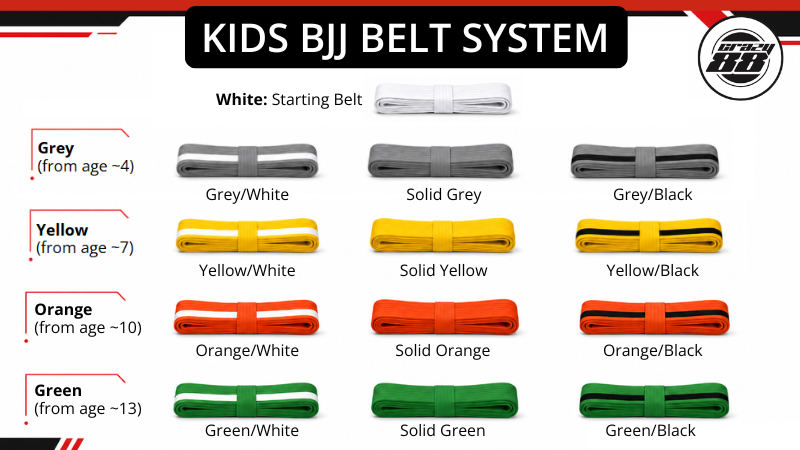
The structure works like this: kids start at white belt, then move through four colors, grey, yellow, orange, and green, with each color split into three sub-ranks: color-with-white-stripe, solid color, and color-with-black-stripe. That is 1 white belt plus 4 colors times 3 sub-ranks, for 13 total belts in the kids BJJ belt system. Grey belts start around age 4, yellow around 7, orange around 10, and green around 13.
Our kids BJJ program at Crazy 88 follows this full youth system, so parents always know exactly where their child stands and what comes next.
What Happens at Age 16
At 16, youth practitioners transition into the adult Brazilian Jiu-Jitsu belt ranks. White belts stay at white. Grey, yellow, and orange belts typically move to blue belt, while green belts can be promoted to blue or purple at the instructor’s discretion based on the student’s skill level. And to clear up a common misconception: there is no junior black belt in BJJ. No one under 19 wears black.
How Long Does It Take to Get a BJJ Black Belt?
Most practitioners reach black belt in roughly 10 years of consistent training, though the real range varies widely from person to person.
Several factors move that number: how many times per week you train, whether you compete (higher training volume and intensity accelerate skill), natural aptitude, and your instructor’s promotion standards. Someone training five days a week with regular competition will progress very differently than someone training twice a week.
The IBJJF’s minimum time-in-grade requirements, about 2 years at blue, 18 months at purple, and 1 year at brown, represent the floor, not the average. Almost nobody hits the minimums at every belt. Real promotions come when your grappling proves you are ready. That slow pace is a feature, not a bug. Brazilian Jiu-Jitsu is known for slow, meaningful promotions compared to other martial arts, and it is exactly why a BJJ rank means something. When you see someone wearing a purple belt, you know what they can do.
BJJ Stripes Explained
Stripes are progress markers within a belt, not separate ranks. On the adult colored belts, students can earn up to 4 stripes before being considered for promotion to the next belt. Stripes are usually small strips of tape or cloth added to the black bar on the belt, and they give students visible checkpoints during the years between belt promotions.
Worth knowing: The IBJJF doesn’t officially recognize stripes below black belt. They’re a motivational and tracking tool, and how (or whether) they’re used varies from school to school. Some academies award them on a schedule, others by skill milestones, and some skip them entirely. At black belt, the markings become formal. Black belt stripes are the degrees covered above, awarded under strict IBJJF time requirements and carrying real rank significance.
Why BJJ Belts Are Harder to Earn Than in Other Martial Arts
Here is the thing that separates Brazilian Jiu-Jitsu from most martial arts: there is no formal testing curriculum mandated by the IBJJF. No memorized forms, no choreographed demonstrations. Promotion is performance- and time-based, decided at your instructor’s discretion based on what you can do.
And what you can do gets tested constantly. Live rolling, full-resistance sparring is built into nearly every BJJ class, which means every belt reflects functional, pressure-tested skill against opponents who are genuinely trying to beat you. You cannot fake your way through a hard round.
This is exactly why a BJJ blue belt is widely respected as a real self-defense milestone. In many martial arts, the first promotion is a participation marker. In Brazilian Jiu-Jitsu, it means you have spent serious mat time proving your technique works on fully resisting people, and that is a standard the art refuses to lower.
Start Your BJJ Belt Journey at Crazy 88 MMA
Every black belt in Maryland started exactly where you are right now: white belt, day one, no experience required. The only step that matters is the first one, getting on the mat. At Crazy 88 MMA, we grade students holistically; effectiveness, skill, knowledge, mindset, and your individual goals all factor into your belt progression. Our Brazilian Jiu-Jitsu (Gi) classes and No-Gi Brazilian Jiu-Jitsu classes take students from complete beginner to competition-ready, with dedicated kids programs following the full youth belt system.
If you’re looking for BJJ training in Maryland, we’ve got you covered with three locations across Central Maryland: Elkridge (Howard County), Owings Mills (Baltimore County), and Severna Park (Anne Arundel County).
Ready to earn your first stripe? Start your 7-day free trial at the Crazy 88 MMA location nearest you and experience our Brazilian Jiu-Jitsu programs for yourself, no experience needed, just show up ready to learn.
Frequently Asked Questions (FAQs)
What are the BJJ belts in order?
The BJJ belts in order for adults are white, blue, purple, brown, and black. Beyond black belt, the order continues to coral (red-and-black at 7th degree, then red-and-white at 8th degree) and finally red belt at 9th and 10th degree. Kids ages 4 to 15 follow a separate order: white, grey, yellow, orange, and green.
Which BJJ belt is hardest to get?
Blue belt is widely considered the hardest to get past, because it is the longest rank on the ladder and the one where the most students quit. The technical demands jump sharply and progress feels slow, so pushing through blue belt is what separates lifelong practitioners from people who drop out early. Black belt is harder in absolute terms, but blue is the belt most students never make it beyond.
What is the rarest belt in BJJ?
The red belt is the rarest belt in Brazilian Jiu-Jitsu. It represents the 9th and 10th degrees of black belt and requires roughly 48 years of activity at black belt under IBJJF minimums, so almost no one earns it before their late sixties. The 10th degree is rarer still, having been reserved for the Gracie brothers who founded the art.
How many belts are in BJJ?
There are 5 primary adult belts in BJJ: white, blue, purple, brown, and black. Counting the ranks beyond black belt, the full IBJJF system has 8 belt colors, adding two coral belts and the red belt. Kids ages 4 to 15 use a separate 13-belt system.
How long does it take to get a BJJ black belt?
Most people take about 10 years of consistent training to earn a BJJ black belt. The exact time depends on training frequency, competition experience, natural aptitude, and your instructor’s standards. The IBJJF’s minimum time-in-grade requirements (about 2 years at blue, 18 months at purple, 1 year at brown) are a floor, not an average, and few practitioners hit the minimum at every belt.
Related Articles