Mastering Muay Thai takes 10 to 15 years, the point where other practitioners come to you for answers. Long before that, students training three times per week reach functional competence with the fundamentals in 12 to 15 months, spar productively at 18 to 24 months, and are competition-ready in 2 to 3 years. What moves those numbers is training frequency and consistency, not talent or athletic background.
You do not have to wait years to see progress. Muay Thai gives you something to work toward at every stage, from learning your first stance and combination to moving comfortably in sparring and eventually testing your skills in competition. Understanding what each stage takes helps you set realistic expectations, measure your progress, and stick with it long enough to get good. Here is what happens at each stage, what changes the timeline, and what quietly slows most people down.
What Does “Mastering” Muay Thai Mean?
Muay Thai timelines feel vague because “mastering Muay Thai” describes four different goals, each running on a different clock. Separating them is the first step to putting a real number on your progress.
- Learning the techniques: You know what a teep is, you can throw a rear roundhouse on a bag, and you can follow along in class without getting lost.
- Using them under pressure: You can throw what you intend to throw while someone is actively trying to hit you. This is a different skill from the first one, and the gap between them is bigger than almost anyone expects.
- Competing: You can safely and competitively fight an amateur bout. This is a commitment level, not a skill level.
- Mastery: You have developed a personal style, you can diagnose and fix other people’s problems, and newer students seek you out. This is measured in years, not months.
Crazy 88 uses a five-stage framework with Muay Thai students in Central Maryland, because it gives you something more useful to aim at than a number on a calendar. Each stage assumes three 90-minute classes per week, and mat hours are the more reliable measure because they hold true regardless of your schedule.
| Stage | What you can do | Time at 3x/week | Mat hours |
|---|---|---|---|
| 1. Comfortable in class | Stance, guard, basic strikes, session rhythm | 1 to 3 months | 20 to 60 |
| 2. Competent at fundamentals | Core weapons with real power, can hold pads | 12 to 15 months | 200 to 250 |
| 3. Functional under pressure | Spar a peer, manage distance, stay composed | 18 to 24 months | 320 to 430 |
| 4. Developed practitioner | Own style, trains with anyone, coaches others | 2 to 5 years | 430 to 1,000+ |
| 5. Toward mastery | Technical depth, ring IQ, can teach | 10 to 15 years | 2,000+ |
How Long Does It Take to Get Good at Muay Thai?
Getting good at Muay Thai takes 12 to 15 months of training three times per week, or roughly 200 to 250 mat hours. At that point your jab, cross, teep and roundhouse feel like your own tools rather than techniques you are consciously recalling, and you can hold pads well enough that a partner gets a real round out of you.
Good in the sense of handling yourself against a resisting opponent takes longer, closer to 18 to 24 months, because timing and composure only develop against another person. Comfort in class, which is what most beginners actually mean when they ask this question, arrives much sooner, usually within 4 to 8 weeks.
Is There a Belt System in Muay Thai?
No, Traditional Muay Thai has no universal belt ranking, which is why the timeline question gets asked so often without clear answers. Some gyms award Prajioud armbands, colored bands worn on the upper arm, to mark levels. Others build their own internal fundamentals-to-advanced progression, as Crazy 88 does. Amateur competition is governed by bodies like the International Federation of Muaythai Associations, but none of that produces a belt you can hang on a wall.
Muay Thai progress therefore gets measured two ways: by what you can do, and by how many hours you have spent on the mats. Both are more honest than a rank.
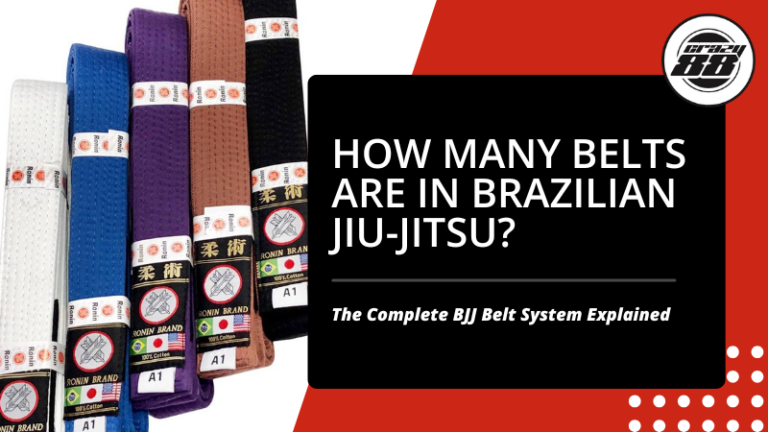
Muay Thai vs. BJJ: Which Takes Longer to Learn?
Muay Thai produces usable skill faster than Brazilian Jiu-Jitsu, roughly 12 to 15 months to functional competence against 18 to 24 months, but BJJ gives you clearer progress markers and lets you compete far sooner. Both arts reach a comparable expert horizon at 10 to 15 years.
| Factor | Muay Thai | Brazilian Jiu-Jitsu |
|---|---|---|
| Progress markers | Skills and mat hours, no universal belts | Belt system, white through black |
| Feels functional | 12 to 15 months | 18 to 24 months, the blue belt range |
| Time to expert level | 10 to 15 years | 10 to 12 years to black belt |
| Realistic first competition | 2 to 3 years | 6 to 12 months |
| Live practice ramp | Gradual, controlled intensity | Near full intensity within months |
The difference comes down to consequence. In BJJ you can roll at close to full intensity from your first few months, because a bad decision costs you a submission rather than a concussion, so live repetitions accumulate quickly. In Muay Thai, sparring is introduced gradually and at controlled intensity, which slows the accumulation of pressure-tested reps but keeps you healthy enough to train for a decade. Students who cross-train both arts at Crazy 88 usually notice their Muay Thai feels usable first and their BJJ feels measurable first.
The Muay Thai Timeline, Stage by Stage
Time alone does not tell you how far you have come. What matters is what you can do, so these stages are organized around skills and abilities visible in training rather than months attended. Train more often and you may progress faster. Train less consistently and the same milestones can take considerably longer. Use these ranges as a practical guide, not a deadline.
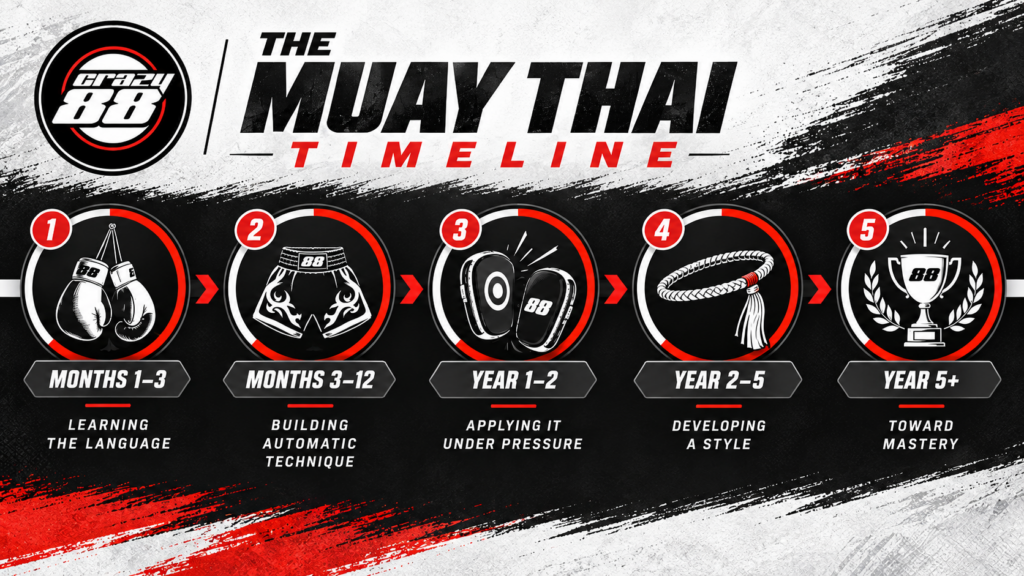
Months 1 to 3: Learning the Language
By the end of your first three months, you can hold a proper stance and guard, throw a jab-cross that lands with the right knuckles, teep to create space, and get a rear roundhouse to the bag with your hip rotating instead of your arm swinging. You have held pads for a partner at least a few times and started to understand why pad work feels different from bag work. You will also feel uncoordinated, and that is not a warning sign. Muay Thai asks your hips, hands, shins and eyes to cooperate on tasks they have never been asked to do together. Week one is awkward for everybody, including the students who eventually become the best in the room.
By week six to eight, most beginners at Crazy 88 report that they have stopped dreading the unfamiliarity and started looking forward to class.
Months 3 to 12: Building Automatic Technique
This is where technique stops being something you consciously remember and starts being something you own. Three- and four-strike combinations come out without narration. Pad rounds get productive, meaning your partner gets a real round out of you rather than a favor. Basic clinch entries are there too, and finding a plum position no longer involves panic.
Defensive habits form in the same window. Your hands come back up on their own and you check a low kick without being told. Toward the end of this stretch, light technical sparring usually enters the picture. Not hard rounds. Controlled, cooperative, coach-supervised work where the goal is timing rather than damage.
Year 1 to 2: Applying It Under Pressure
This is the stage where technique and fighting separate, and where most people discover they are two different things. You can spar a partner at a similar level without your game plan evaporating in the first thirty seconds. You manage distance deliberately, stepping in and out rather than standing in range hoping. You start landing counters instead of only leading, and you begin reading a partner, noticing that they drop their lead hand when they kick and doing something about it.
None of this can be built alone. Distance, timing and composure require another human being, because a bag never fakes, never counters and never makes you uncomfortable.
Year 2 to 5: Developing a Style
The advanced tools develop in this window, including spinning elbows, sweeps, catch-and-return, level changes, and clinch work that controls a partner rather than just holding on. More importantly, you develop ring IQ, the sense of when to press, when to circle and when to trade. You start to look like someone rather than like a curriculum.
This is also where students typically begin coaching newer members without being asked, which is one of the clearest signals that a skill has become real. If you can explain why a roundhouse is losing power, you understand it.
Year 5 and Beyond: Toward Mastery
Ten to fifteen years is the honest figure for the level where other practitioners seek you out for answers. In Thailand, an experienced instructor earns the title of Kru, which is closer to “teacher” than to any rank, and it reflects both technical depth and years spent transmitting the art to other people.
Mastery in Muay Thai is a direction, not a finish line. Fighters with a hundred professional bouts are still fixing things. That is not a discouraging fact. It is a large part of why people who start Muay Thai are still training a decade later.
Why Thailand Timelines Do Not Apply to You
Almost every Muay Thai timeline published online is quietly benchmarked against Thai fighters, and almost none of them say so. A professional from a Bangkok camp likely started at age eight, trained twice a day six days a week, and had fifty fights before turning twenty. By the time that fighter is twenty-two, they have accumulated somewhere in the range of ten to fifteen thousand hours of training under professional supervision.
You are not going to match that, and it has nothing to do with your ability. A working adult training three evenings a week accumulates roughly 215 hours per year. A Thai fighter in a full-time camp accumulates that in about eight weeks. Comparing your one-year mark to their one-year mark is not a fair comparison.
The relevant question is not how fast a Thai professional develops. It is how fast an adult with a full-time job, a commute and three free evenings a week develops. That answer is genuinely encouraging: twelve to fifteen months to real competence with the fundamentals, two years to being a legitimately useful sparring partner, and a lifetime of steady refinement after that. Measured against your own schedule instead of someone else’s childhood, the timeline looks entirely reasonable.
How Training Frequency Changes Your Muay Thai Timeline
Skill development in Muay Thai runs on accumulated mat hours, not calendar months, so changing your weekly frequency shifts every milestone. Functional competence with the fundamentals takes roughly 200 to 250 mat hours. That figure comes from tracking students through the Crazy 88 fundamentals track across three Maryland gyms since 2005, and it is where all of the math below comes from. At a typical 90-minute class, the conversion looks like this:
| Training frequency | Mat hours per year | Functional competence | Productive sparring | Competition readiness |
|---|---|---|---|---|
| 2x per week | ~145 hours | 18 to 24 months | 2.5 to 3 years | 4+ years, if at all |
| 3x per week | ~215 hours | 12 to 15 months | 18 to 24 months | 2 to 3 years |
| 4x per week | ~290 hours | 9 to 12 months | 12 to 18 months | 18 months to 2 years |
| 5 to 6x per week | ~380 to 430 hours | 6 to 9 months | 9 to 12 months | 12 to 18 months |
Two caveats before reading that table as a recipe for training six days a week.
First, consistency at three sessions per week beats bursts at six. Injury and burnout reset your progress in a way that no amount of volume compensates for. A student who trains three times weekly for four straight years accumulates more usable skill than one who trains six times weekly for eight months. Your nervous system needs repetitions spaced closely enough that you are not relearning, but it also needs recovery to consolidate what you drilled.
Second, the six-month mark is where most people quit. Not because the training got harder, but because the visible week-over-week improvement of the first few months flattens out. The gains do not actually stop. They move from learning new techniques to refining the ones you already have, which is much harder to notice and much more valuable. If you can recognize that stretch as a normal phase rather than evidence you have hit your ceiling, you will train through it, and you will end up in a very small group of people who did.
Read: Overtraining vs. Under-training – Which One Am I Doing?
How Long Before You See Physical Results From Muay Thai?
Most students training Muay Thai three times per week notice better conditioning within 4 to 6 weeks, visible changes in body composition by around 3 months, and a clearly different level of overall fitness by 6 months. Physical results arrive considerably faster than technical skill, which is worth knowing if fitness is your primary reason for starting.
- Weeks 1 to 4: Recovery between rounds improves first. You are noticeably less winded at the end of the month than you were at the start, even though nothing about the class got easier.
- Weeks 4 to 12: Shoulders, core and hips adapt to holding a guard and throwing kicks for an hour. This is usually when other people start commenting.
- Months 3 to 6: A real cardiovascular base develops, hip mobility opens up, and your shins gradually tolerate pad and bag work that would have been uncomfortable in month one. Shin conditioning is a slow adaptation from consistent normal training, not something to accelerate deliberately.
- Months 6 and beyond: Progress shifts from general fitness to sport-specific capacity, meaning you can express technique for longer without your form degrading.
What Slows Down Muay Thai Progress?
Most students do not stall because they lack talent. They stall because a few predictable habits get in the way of consistent training and skill development. Across hundreds of students working through the same learning curve at Crazy 88, the same five obstacles come up repeatedly. None of the five are permanent. All of them are fixable, and recognizing them early can save you months of frustrated training.
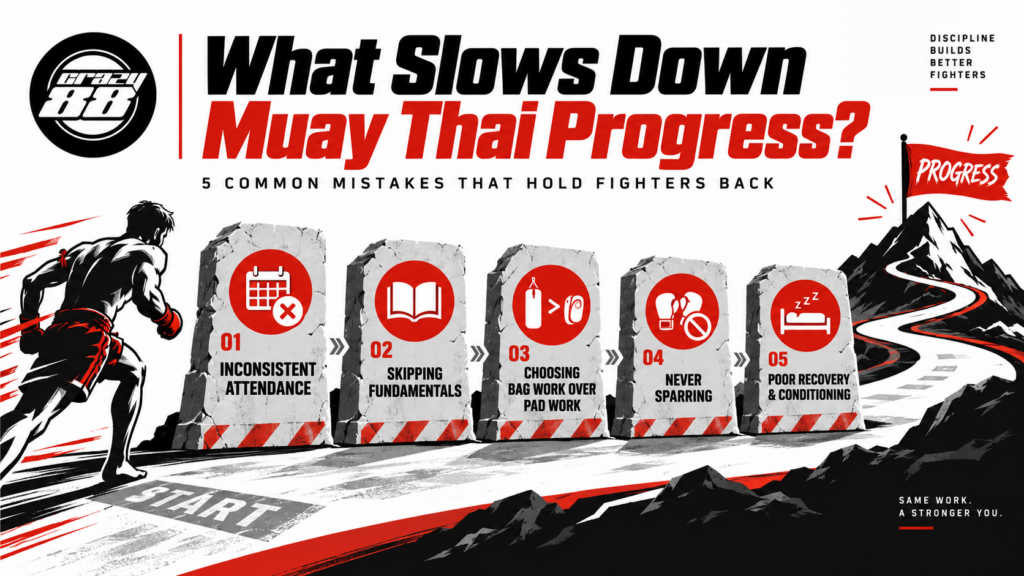
1. Inconsistent Attendance
This is the single biggest factor, and it is not close. Two sessions a week every week beats four sessions one week and none for the next three. When gaps get long enough, each class becomes a partial restart. Pick two or three specific class times, put them on your calendar as recurring commitments, and defend them the way you would defend a meeting. Frequency beats intensity, and reliability beats both.
2. Skipping Fundamentals to Chase Flashy Techniques
Spinning elbows and jumping knees are fun to drill and almost useless without the platform underneath them. Students who spend a year polishing exotic strikes on top of a mediocre jab plateau hard. Keep attending fundamentals classes long after you technically graduate from them. The best strikers in the Crazy 88 gyms are the ones with the most boring, most repeated basics.
3. Avoiding Pad Work in Favor of Bag Work
The heavy bag never moves, never gives feedback, and never tells you your elbow is flaring. One attentive round on the pads with a coach correcting you in real time is worth several rounds on the bag. Treat pad rounds as the main event of class rather than the part between conditioning, and ask your holder to call out what they see.
4. Never Sparring at All
If your goal is Stage 3 or beyond, there is no substitute for sparring. Distance, timing, composure and the ability to think while being pressured only develop against a person. Start with light technical rounds against a trusted partner at a controlled intensity, supervised by a coach. Nobody is asking you to take a hard round in month three.
5. Poor Recovery and Conditioning
Shin soreness, nagging shoulders, chronic sleep debt and no strength base all cap how much you can train and how well you absorb what you do train. Students who push through accumulating injuries lose far more time than students who address them early. Sleep, hydrate, do some basic strength work, and tell a coach when something hurts instead of quietly modifying around it for six months.
How to Progress Faster Without Training More
If three classes a week is what your schedule allows, that is what your schedule allows. Six tactics get more out of those hours, and coaches at Crazy 88 watch all six work in real time with Maryland students.
- Film yourself once a month: One round of shadowboxing or pad work on your phone, the same combination each time. The gap between what you think you look like and what you actually look like is where most of your fastest improvement is hiding.
- Pick one technique per month as your focus: Not five. One. Spend a month making your lead hook or your switch kick genuinely good, then move on. Diffused attention across everything produces diffused improvement in everything.
- Hold pads attentively rather than passively: Holding is not a rest period. When you feed realistic angles and call out what you see, you learn timing and distance from the other side of the strike. Good pad holders improve faster than good pad hitters.
- Ask for correction instead of waiting for it: In a full class, the student who asks “what is wrong with my roundhouse?” gets a specific answer that the student silently hoping to be noticed does not.
- Shadowbox ten minutes at home: No equipment, no gym time. Ten focused minutes a few nights a week on footwork and the one technique you are working on adds up to dozens of extra hours a year of nervous-system repetition.
- Train with people slightly better than you: Not dramatically better, which is discouraging and unproductive. Slightly better, consistently. It is the most reliable way to raise your own floor.
None of these six tactics require additional mat time. They require attention. The students who improve fastest in the Crazy 88 Muay Thai program are almost never the ones training the most hours. They are the ones extracting the most from the hours they train.
Do You Need to Compete to Get Good at Muay Thai?
No. You do not need to compete to become very good at Muay Thai. That distinction is worth making because the image of Muay Thai as something only future fighters do keeps plenty of people from ever walking through the door.
Most students at Crazy 88 train for fitness, stress relief, confidence, personal growth, or simply because they enjoy being part of a community. They never step into a competition ring, and many become technically excellent practitioners. Competition is one way to test and develop your skills, but it is not the finish line, and it is completely optional.
What Competing Genuinely Develops
- Pressure tolerance: Performing a technique in front of a crowd against a real opponent is a different nervous-system experience than performing it in class. Fighters build composure faster.
- Game planning: Fight preparation forces you to identify your best tools and build a strategy around them, which most non-competitors never do explicitly.
- Conditioning: Camp-level conditioning is a step above general fitness training, and it changes what you are physically capable of expressing.
What Competing Does Not Do
- It does not make your technique cleaner. Technique comes from drilling and coaching. Plenty of competitors have sloppier fundamentals than dedicated non-competing students.
- It does not make you a better teacher or training partner. That comes from years of attentive practice and paying attention to other people.
- It does not accelerate everything. A fight camp compresses conditioning and mental preparation, then usually costs you recovery time afterward.
If competing appeals to you, Crazy 88 has coaches with real competitive experience and a structured path toward it, including bouts sanctioned through USA Muaythai, the national federation recognized by the USOPC. If it does not, no stage of the Muay Thai timeline closes off. You can reach Stage 4 as a developed practitioner without ever stepping into a ring.
Training Muay Thai in Maryland: Start the Clock
Every Muay Thai training timeline starts the same way, with a first class. Crazy 88 Mixed Martial Arts has been part of the Maryland martial arts community since 2005, and Muay Thai kickboxing classes run at all three Central Maryland locations, with a fundamentals track built specifically for people who have never thrown a punch.
There is no experience requirement, no fitness prerequisite, and no expectation that you compete. Just structured coaching, a room full of people who were beginners themselves not long ago, and morning, afternoon and evening class times so Muay Thai training fits around your job instead of the reverse.
Your first week is on us. Every new student gets a 7-day free trial at any Crazy 88 location. No contracts, no commitment, just a real look at what Muay Thai training in Maryland feels like. Pick the gym closest to you and claim your free week:
- Elkridge (Howard County): Start your free week in Elkridge
- Owings Mills (Baltimore County): Start your free week in Owings Mills
- Severna Park (Anne Arundel County): Start your free week in Severna Park
Frequently Asked Questions About Learning Muay Thai
How long does it take to master Muay Thai?
True mastery takes 10 to 15 years of consistent training. Along the way, most students training three times per week reach functional competence with the fundamentals in 12 to 15 months, spar productively at 18 to 24 months, and are competition-ready in 2 to 3 years if they choose to compete.
How long does it take to get good at Muay Thai?
It depends what you mean by good. You will feel comfortable in class within 4 to 8 weeks. Your jab, cross, teep and roundhouse will feel like yours rather than something you are consciously remembering at roughly 200 to 250 total mat hours, which is about 12 to 15 months at three classes per week.
Is there a belt system in Muay Thai?
No. Traditional Muay Thai has no universal belt ranking. Some gyms use Prajioud armbands or their own internal level systems to mark progress, but there is no international standard, which is why Muay Thai timelines are described in skills and training hours rather than ranks.
How many times a week should I train Muay Thai as a beginner?
Three classes per week is the sweet spot for most beginners, frequent enough to build technique without resetting between sessions and sustainable enough to keep up for years. Two classes per week still produce real progress on a longer timeline, and consistency at two beats an inconsistent five.
How long before I can have my first Muay Thai fight?
Most students who choose to compete are ready for a sanctioned amateur bout after 2 to 3 years of training three times per week. Students with a strong athletic background sometimes reach that point closer to 18 months. Readiness is a coaching decision rather than a calendar one, and it depends on sparring experience and conditioning as much as technique. Amateur kickboxing bouts here are regulated by the Maryland State Athletic Commission, and contestants must hold a current license, which includes a medical requirement.
How long does it take to see physical results from Muay Thai?
Better conditioning shows up within 4 to 6 weeks of training three times per week, visible changes in body composition by around 3 months, and a clearly different level of overall fitness by 6 months. Physical results arrive well before technical skill does.
Am I too old to start Muay Thai?
No. Age affects recovery and the ceiling for high-level competition, but it has very little effect on the goal most adults actually have, which is developing real skill and enjoying the training. Crazy 88 has students in their 40s, 50s and 60s training Muay Thai across all three Maryland locations and reaching genuine technical proficiency.
Do I have to spar or compete to get good at Muay Thai?
Competing is always optional and most students never do it. Sparring is what turns technique into fighting ability, so students aiming for Stage 3 and beyond will spar eventually, but it is introduced gradually, at controlled intensity, and only when you and your coach agree you are ready.
How long does it take to learn Muay Thai well enough for self-defense?
Basic usable striking, meaning a real jab, cross, teep and roundhouse plus the ability to keep your guard up under stress, develops in roughly 6 to 12 months of consistent training. Composure under pressure comes from partner work and light sparring, not solo bag work.
Where can I train Muay Thai in Maryland?
Crazy 88 offers Muay Thai kickboxing classes at three Central Maryland locations: Elkridge in Howard County, Owings Mills in Baltimore County, and Severna Park in Anne Arundel County. Every new student gets a 7-day free trial at any location.
Related Articles