
Gi and No-Gi Brazilian Jiu-Jitsu teach the same core principles: leverage, position, and control, but Gi and No-Gi involve different strategies and approaches. Gi BJJ is trained in a heavy cotton uniform whose collar, sleeves, and pants become grips, which makes the game slower, more technical, and more grip-dependent. No-Gi is trained in a rash guard and shorts with nothing to grab, so control comes from underhooks, body locks, and wrestling, and the pace is much faster. Both teach the same fundamentals of leverage, position, and control.
Which one you should start with depends on your goals, your schedule, and whether you are ultimately aiming at MMA, self-defense, or sport competition. This guide breaks down what each style is, how they differ point by point, and how the skills carry from one to the other. We cover which is friendlier for beginners, which holds up better for real self-defense, and how each fits into competition and MMA.
What Is Gi BJJ?
Gi BJJ is Brazilian Jiu-Jitsu trained in a traditional uniform consisting of a heavy cotton jacket, matching pants, and a belt. The fabric itself becomes a tool for gripping, controlling, and submitting your opponent. Adapted from Japanese jiu-jitsu and judo, it is the classic form of the art and the place most practitioners build their foundation. The belt system runs white, blue, purple, brown, and black, and under IBJJF competition rules, a Gi must be a single solid color of white, royal blue, or black, with no mixing of the three.
What Is a Gi?
A Gi (also called a kimono) is the uniform worn in traditional Brazilian Jiu-Jitsu. It has three parts: a thick jacket built to survive constant pulling, a pair of reinforced cotton pants, and a belt that marks your rank. The collar and lapels are stiff and slightly padded, so they hold up to gripping without choking the person wearing them. Those sleeves, lapels, and pant legs are not just clothing. They are handles your training partner will use to control you, and that you will use right back.
How Gi Training Works
Because there is so much fabric to grab, Gi rounds tend to be slower and more methodical. Battles are often won or lost in grip-fighting exchanges before a sweep or a pass ever happens. That deliberate pace gives you time to think, to link techniques together in sequence, and to feel exactly how leverage works. For a newer student, that is a gift. The Gi lets you slow down a bigger, stronger partner and win with technique instead of athleticism.
Skills You Develop in Gi Jiu-Jitsu
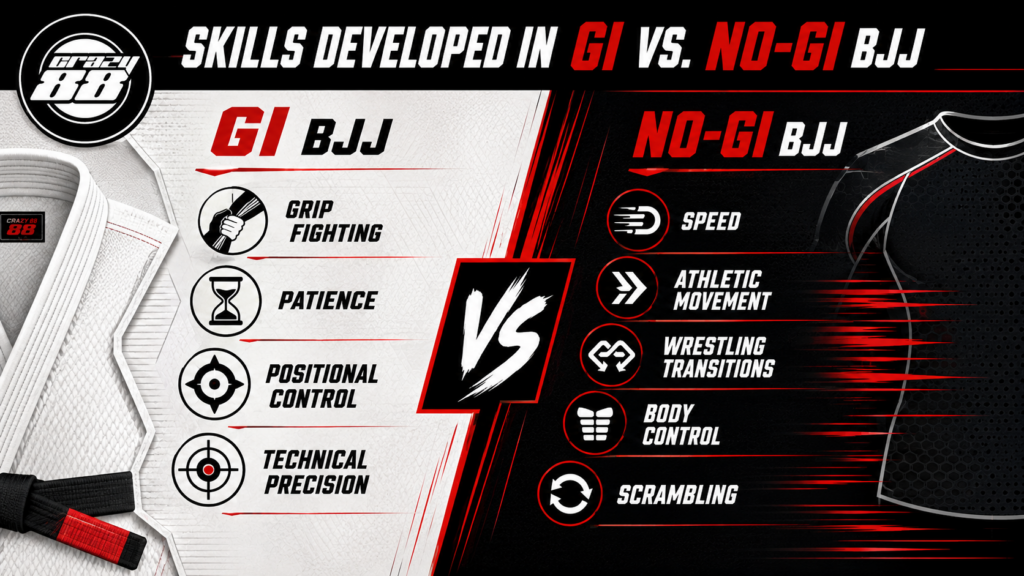
Training in the Gi sharpens a specific set of tools:
- Grip fighting: You learn to break your opponent’s grips and establish your own on the collar, sleeves, and pants, which is the opening move of nearly every Gi exchange.
- Patience: The slower pace teaches you to wait for the right moment instead of forcing it, a habit that pays off everywhere in BJJ.
- Positional control: The fabric makes it easier to pin and hold a position, so you build a deep understanding of what real control feels like.
- Technical precision: With more grips and more positions to manage, the Gi rewards clean, detailed technique over speed and strength.
What Is No-Gi BJJ?
No-Gi BJJ is Brazilian Jiu-Jitsu trained without the traditional uniform. Practitioners wear a rash guard and shorts, so control comes from gripping the body rather than the clothing. With no collars or sleeves to slow things down, no-Gi is faster, more athletic, and much closer to what you would see in wrestling or MMA.
What Do You Wear for No-Gi?
The no-Gi uniform is simple. It includes a rash guard and a pair of grappling shorts made without pockets or zippers that could catch a finger or a toe. Many grapplers add compression spats or leggings underneath for extra protection against friction, especially while they are still getting used to the mat. Everything is lightweight, stretchy, and breathable, built for fast movement and heavy sweat rather than for gripping.
How No-Gi Training Differs
With no fabric to hold, control has to come from somewhere else, namely underhooks, wrist and head control, body locks, and relentless pressure. Rounds move quickly. Scrambles happen in a blink, transitions chain together, and a position you owned a second ago can disappear just as fast. That speed is a big part of why no-Gi feels so athletic, and why it maps so cleanly onto MMA and onto self-defense situations where nobody is wearing a jacket.
Skills You Develop in No-Gi
No-Gi builds a different toolkit:
- Speed: The faster pace trains you to react and move before your opponent can settle.
- Athletic movement: Without grips to anchor you, you develop better balance, hip mobility, and overall body coordination.
- Wrestling transitions: Clinch work, takedowns, and takedown defense are front and center in no-Gi.
- Body control: You learn to control an opponent using pressure, framing, and positioning instead of fabric.
- Scrambling: You get comfortable in chaotic, fast-changing exchanges and learn to come out on top of them.
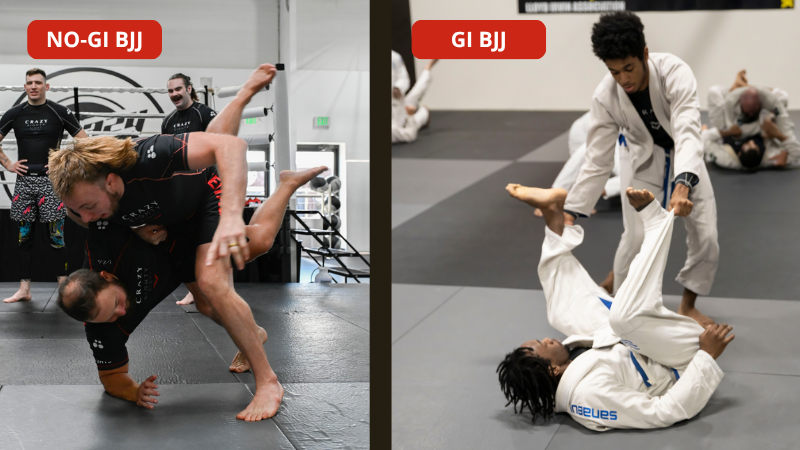
Key Differences Between Gi and No-Gi BJJ
Both styles share the same DNA, but the details set them apart. Here is how Gi and no-Gi compare across the areas that matter most.
Clothing & Equipment
Gi training requires a full uniform including a jacket, pants, and belt, made from thick, durable cotton. No-Gi calls for a rash guard and grappling shorts, and that is it. The uniform is more than a wardrobe choice. In the Gi, the clothing is part of the game. In no-Gi, its absence changes how you grip and control entirely.
Cost and Gear Upkeep
A Gi is the bigger investment. Entry-level Gis from major brands generally start under $100, while premium weaves run higher, and a Gi needs to be washed and fully dried after every single session to stay clean and odor-free. No-Gi gear is cheaper, easier to find, and simpler to launder. A couple of rash guards and a pair or two of shorts will get you started, which is one reason many people find no-Gi easier on both the wallet and the laundry routine.
Grip Fighting
In the Gi, grip fighting revolves around the fabric. You are battling for the collar, the sleeves, and the pants to set up sweeps, passes, and submissions. In no-Gi, there is nothing to hold, so grips shift to the body. Wrist control, underhooks, overhooks, and head control do the same job the collar and sleeves do in the Gi.
Speed and Pace
Gi is usually slower and more methodical, because grips let you stall an exchange, control your opponent, and work step by step. No-Gi is faster and more dynamic, because with less to grab, movement flows more freely and the whole match tends to happen at a higher tempo.
Guard Styles
Fabric grips open up guards that only exist in the Gi, like spider guard, lasso guard, and worm guard, all of which use the sleeves and lapels to control an opponent. No-Gi leans on guards that do not need fabric, such as butterfly guard, half guard, and single-leg X, where hooks, frames, and body positioning do the controlling.
Passing Strategy
Passing the guard in the Gi often means using grips on the pants and lapels to pin your opponent’s hips and legs before you work around them. In no-Gi, passing relies more on speed, pressure, and hand-fighting on the body, because you cannot nail someone in place with a pant grip. The passer who cannot slow the action down has to be sharper with timing and pressure.
Submissions
This is where the two styles look most different. Gi opens up fabric-dependent finishes like collar chokes, lapel chokes, and Ezekiel chokes that simply are not possible without a jacket. No-Gi leans on submissions that need no clothing at all, including leg locks, guillotines, rear-naked chokes, arm triangles, and other grip-free attacks. Learning both broadens your submission game considerably.
Takedowns and Wrestling
No-Gi overlaps heavily with wrestling. Double legs, single legs, body locks, and hard scrambles show up constantly, since there is no Gi to grip on the feet. Gi takedowns can also draw on the uniform, borrowing collar-and-sleeve control and judo-style throws. Both build a standing game, but no-Gi’s is the one that most closely resembles freestyle grappling and MMA.
Overall Training Experience
Put simply, Gi training feels like physical chess. It is detailed, patient, and grip-heavy. No-Gi feels fast, scrambly, and athletic. Neither is better. They are two lenses on the same art, and most complete grapplers end up appreciating what each one teaches.
Do the Skills Transfer Between Gi and No-Gi?
Yes, heavily but not perfectly, and that imperfect overlap is exactly why training both makes you a better grappler. Position, pressure, and submission chains are universal. A solid mount is a solid mount, a guard pass follows the same logic, and the mechanics of a rear-naked choke do not care what you are wearing. Everything you learn about controlling an opponent and finishing from a dominant spot carries directly across the line.
The interesting part is where the two styles strengthen each other rather than just repeat. The Gi forces you to survive against grips and to control with precision, which makes your no-Gi tighter and harder to escape. No-Gi forces you to hold position and finish without any handles, which makes your Gi game more athletic and much harder to stall against. Train only one and you build a blind spot. Train both and each style quietly patches the other’s weakness. That mutual reinforcement is the real reason so many serious students refuse to choose one.
Is Gi or No-Gi Better for Beginners?
Most beginners do well starting in the Gi, and there is a simple reason. The slower pace makes it easier to learn control, and the fabric gives you a way to slow a bigger, faster partner down while your technique catches up. That controlled environment is ideal for developing fundamentals, building good habits, and gaining the confidence that keeps first-timers coming back.
That said, plenty of beginners fall in love with no-Gi first because it feels athletic and straightforward, and there is genuinely no wrong answer. Neither style is objectively harder. They are hard in different ways. The Gi is more technically complex, with more grips and more positions to keep track of, while no-Gi asks more of your cardio and grip endurance because the pace rarely lets up. If you are unsure, the best starting point is often just the class that fits your schedule. Showing up consistently and building good habits early matters far more than which uniform you put on first.
Which Is Better for Self-Defense?
Both styles are genuinely effective for self-defense, and the honest answer is that consistency matters more than which one you choose. Here is how each holds up in the real world:
- Real-world clothing considerations: In most confrontations, an attacker is wearing grabbable clothing such as a jacket, a hoodie, or a shirt collar, so the fabric grips you drill in the Gi transfer directly to a real situation.
- Grip control: Gi training teaches you to control someone using their clothing, while no-Gi teaches you to control them using their body. Knowing both means you are never dependent on one or the other.
- Escaping bad positions: Both styles drill escapes relentlessly, so you learn to get out from underneath someone and back to safety, which is the single most important self-defense skill BJJ offers.
- Handling larger opponents: Leverage over strength is the entire premise of Brazilian Jiu-Jitsu, and both Gi and no-Gi teach you to neutralize a bigger, stronger person with technique.
- Why both styles have self-defense value: No-Gi builds control that does not rely on fabric, which matters in summer or against torn and slippery clothing, while Gi builds control that uses it. The fullest self-defense skill set draws on both.
If self-defense is your main goal, do not agonize over the choice. Pick the style you will stick with and train it regularly. The person who shows up twice a week will always be more prepared than the one still debating Gi versus no-Gi from the sidelines.
Gi vs. No-Gi for Competition
If you decide to compete, the ruleset you are training under shapes almost everything, including what you wear, which submissions are legal, and how you score.
Read: Why Competiting is Essential to Brazilian Jiu Jitsu Development
Gi Competition Rules
Gi competition is governed most prominently by the IBJJF, which sets strict standards for both the uniform and the techniques allowed. Your Gi must be clean, free of tears, and made of an approved cotton or cotton-like weave in a legal color. Points are awarded for achieving and holding dominant positions such as takedowns, guard passes, mount, and back control, and the submission list is more restricted than in no-Gi, particularly for lower belts.
No-Gi Competition Rules
No-Gi competition tends to be more open, especially under submission-focused organizations. Rulesets like ADCC and other submission-only events reward finishing and permit a broader range of attacks, most notably leg locks that are limited or banned in the Gi. Competitors wear a rash guard and shorts, and while the technique rules are looser, illegal actions like striking or eye contact still bring an immediate disqualification.
IBJJF vs. ADCC Differences
The two rulesets most worth knowing by name are the IBJJF and ADCC. The IBJJF (International Brazilian Jiu-Jitsu Federation) rulebook governs the largest Gi tournaments in the world, including Worlds, Pans, and Europeans, along with its own no-Gi events. It enforces strict uniform requirements, scores positional dominance, and keeps a tighter list of legal submissions; heel hooks, for example, are banned in most IBJJF divisions.
The ADCC (Abu Dhabi Combat Club) ruleset is the premier no-Gi standard and takes the opposite approach: no uniform, a more permissive submission list that allows heel hooks at the top level, and scoring built to reward takedowns, guard passing, and above all, finishing the match. In short, IBJJF is the detail-driven Gi reference point, and ADCC is the fast, submission-hungry no-Gi benchmark that most other grappling events borrow from.
In short, IBJJF is the detail-driven Gi reference point, and ADCC is the fast, submission-hungry no-Gi benchmark that most other grappling events borrow from.
Gi vs. No-Gi for MMA
If MMA is on your radar, no-Gi is the more direct fit, but the Gi still has plenty to offer. Here’s how they factor in.
- Why MMA fighters primarily train no-Gi: There’s no Gi in the cage, so no-Gi’s pace, wrestling emphasis, and grip-free control map almost one-to-one onto MMA. Underhooks, body locks, takedowns, and submissions that don’t need fabric are exactly the tools a mixed martial artist reaches for.
- How Gi training improves technique: The Gi’s slower, detail-heavy game sharpens control, patience, and precise submission setups. Many fighters credit the Gi with tightening their positional control and defense, which carries straight back into their no-Gi and MMA games.
- Why many professional athletes train both: The best grapplers borrow from each side: the technical depth of the Gi and the athletic, grip-free realism of no-Gi. Training both is how a lot of pros build a game that holds up under any conditions.
Should You Train Gi, No-Gi, or Both?
Here’s the simple way to think about it.
Train Gi If…
- You enjoy technical strategy and want to play the physical-chess side of grappling.
- You’re drawn to traditional martial arts and the structure of the belt system.
- You want to compete in Gi tournaments under IBJJF-style rules.
Train No-Gi If…
- You’re interested in MMA and want skills that transfer straight to the cage.
- You enjoy fast-paced, athletic grappling and constant scrambles.
- You have a wrestling background and want to build on it.
Train Both If…
Honestly, most dedicated grapplers should. Cross-training is how you build the most well-rounded game. The Gi gives you patience, precise control, and a deep understanding of position, while no-Gi gives you speed, athleticism, and a standing game built for the real world. Each one covers the other’s blind spots, so training both does not just double your knowledge. It makes every part of your jiu-jitsu sharper.
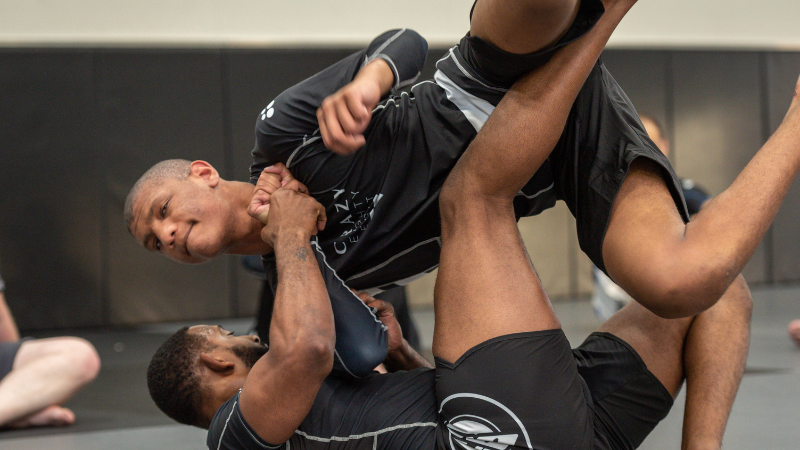
Train Gi and No-Gi at Crazy 88
You do not have to pick a lane at Crazy 88. We run structured Gi Brazilian Jiu-Jitsu and No-Gi Brazilian Jiu-Jitsu programs across our Maryland locations. Many of our students train both to develop a complete grappling game, and our beginner-friendly curriculum makes it easy to start with either one, no experience required.
Ready to Get on the Mat? Start Your Free Trial
Gi and No-Gi Brazilian Jiu-Jitsu are two paths up the same mountain. The Gi rewards patience and precision. No-Gi rewards speed and athleticism. Training both builds the most complete grappler of all. There is no wrong first step, and the only real mistake is standing on the sidelines instead of getting on the mat.
At Crazy 88, the easiest way to find out which style fits you is to try it. We offer a 7-day free trial with no contracts and no experience required. Step onto the mats, train with our coaches, and see how it feels. Explore our Gi BJJ program and our No-Gi BJJ program, then come train at whichever Central Maryland location is closest to you:
- Crazy 88 Elkridge (Howard County) — (443) 283-1450
- Crazy 88 Owings Mills (Baltimore County) — (410) 999-1064
- Crazy 88 Severna Park (Anne Arundel County) — (443) 339-8130
Serving Brazilian Jiu-Jitsu students across Howard County, Baltimore County, and Anne Arundel County. Claim your 7-day free trial and start your jiu-jitsu journey today.
Frequently Asked Questions – Gi vs. No-Gi BJJ
What is the difference between Gi and No-Gi BJJ?
Gi BJJ is trained in a traditional uniform, a jacket, pants, and belt, and uses grips on the collar, sleeves, and pants to control and submit an opponent, which makes for a slower, more technical game. No-Gi BJJ is trained in a rash guard and shorts with no fabric to grip, so control comes from body positioning, wrist and head control, and underhooks, producing a faster, more athletic style. Both teach the same core principles of leverage, position, and control.
Should a beginner start with Gi or No-Gi?
Most beginners do well starting in the Gi because the slower pace makes control easier to learn and the fabric helps you slow down a stronger partner while your technique develops. That said, neither style is objectively harder, and many beginners love starting with no-Gi. If you’re unsure, choose the class that fits your schedule, training consistently matters more than which uniform you wear first.
Is Gi or No-Gi better for self-defense?
Both are effective. Gi grips transfer well to real situations because attackers are usually wearing grabbable clothing, while no-Gi builds control that doesn’t rely on fabric at all. The most important factor is consistency, the style you train regularly will always serve you better than the one you only think about.
Is Gi or No-Gi better for MMA?
No-Gi is the more direct fit for MMA because there’s no gi in the cage, and no-gi’s pace, wrestling, and grip-free control map straight onto mixed martial arts. Gi training still helps, though, by sharpening control, patience, and submission setups. Many professional fighters train both.
What’s the difference between IBJJF and ADCC rules?
The IBJJF governs the largest Gi tournaments and its own no-Gi events, with strict uniform requirements, positional scoring, and a more restricted submission list (heel hooks are banned in most divisions). ADCC is the premier no-Gi ruleset, with no uniform, a more permissive submission list that allows heel hooks at the top level, and scoring built to reward takedowns, passing, and finishing.
Can I train both Gi and No-Gi at Crazy 88?
Yes. Crazy 88 offers structured Gi and No-Gi Brazilian Jiu-Jitsu programs at all three Maryland locations — Elkridge (Howard County), Owings Mills (Baltimore County), and Severna Park (Anne Arundel County). Many students train both to build a well-rounded grappling game, and no experience is required to start with either.